
RoamLife
Complete Guide to Stellplatze in Germany: Everything Motorhome Travelers Need to Know
TL;DR:
- Germany has 4,300+ Stellplatze - more than any other European country
- Cost: Free to EUR60/night (average EUR15-20)
- Facilities: Water, waste disposal, often electricity
- Stay limit: Usually 1-3 nights maximum
- Best finders: stellplatz.info, RoamLife, Promobil app
- Key rule: No "camping behavior" - awnings, chairs, and outdoor living are prohibited
Germany invented the Stellplatz concept, and with over 4,300 dedicated motorhome parking areas, it remains the best-equipped country in Europe for campervan travel. Whether you're chasing fairy-tale castles along the Romantic Road or winding through Black Forest valleys, there's almost always a legal, well-serviced spot to park for the night.
I've spent considerable time touring Germany in a van, and the Stellplatz network makes route planning remarkably stress-free. This guide covers everything you need to know to make the most of these facilities.
What Is a Stellplatz?
A Stellplatz (plural: Stellplatze) is a designated parking area specifically for motorhomes and campervans. The name literally translates to "parking place" or "pitch," but these aren't just car parks - they're purpose-built facilities for self-contained vehicles.
| Feature | Stellplatz | Campsite (Campingplatz) |
|---|---|---|
| Cost | EUR0-60/night | EUR25-70/night |
| Facilities | Basic to good | Full (showers, pools, shops) |
| Booking | Rarely needed | Often required |
| Stay limit | 1-3 nights typical | Unlimited |
| Outdoor living | Prohibited | Encouraged |
| Atmosphere | Parking-focused | Holiday resort |
Important distinction: Stellplatze are designed for short overnight stays, not extended camping. You're expected to arrive, sleep, use services, and move on within 24-72 hours.
Types of Stellplatze
Municipal Stellplatze (Stadtischer Stellplatz)
Run by towns and cities, these are the backbone of the network. Quality varies from basic gravel lots to beautifully landscaped facilities with river views.
- Cost: EUR5-25/night (many under EUR15)
- Facilities: Water, waste disposal, often electricity
- Location: Near town centers, tourist attractions, or swimming areas
Private Stellplatze
Operated by restaurants, hotels, swimming pools, or farms. Often offer better facilities in exchange for patronizing the business.
- Cost: EUR10-30/night (sometimes free with purchase)
- Facilities: Often include toilet access and electricity
- Bonus: Local food, beer gardens, farm shops
Autohof Stellplatze
Service stations near Autobahn exits. Convenient for breaking up long drives, though not the most scenic option.
- Cost: Free to EUR15 (sometimes free with fuel purchase)
- Facilities: 24/7 shops, toilets, sometimes showers
- Security: Generally safer than motorway rest areas
Landvergnugen (Farm Stays)
Germany's answer to France Passion. An annual membership (EUR49) grants access to over 1,200 farms, vineyards, and small producers.
- Cost: Free (membership EUR49/year)
- Facilities: Basic or none - bring self-sufficiency
- Experience: Meet producers, buy local, unique locations
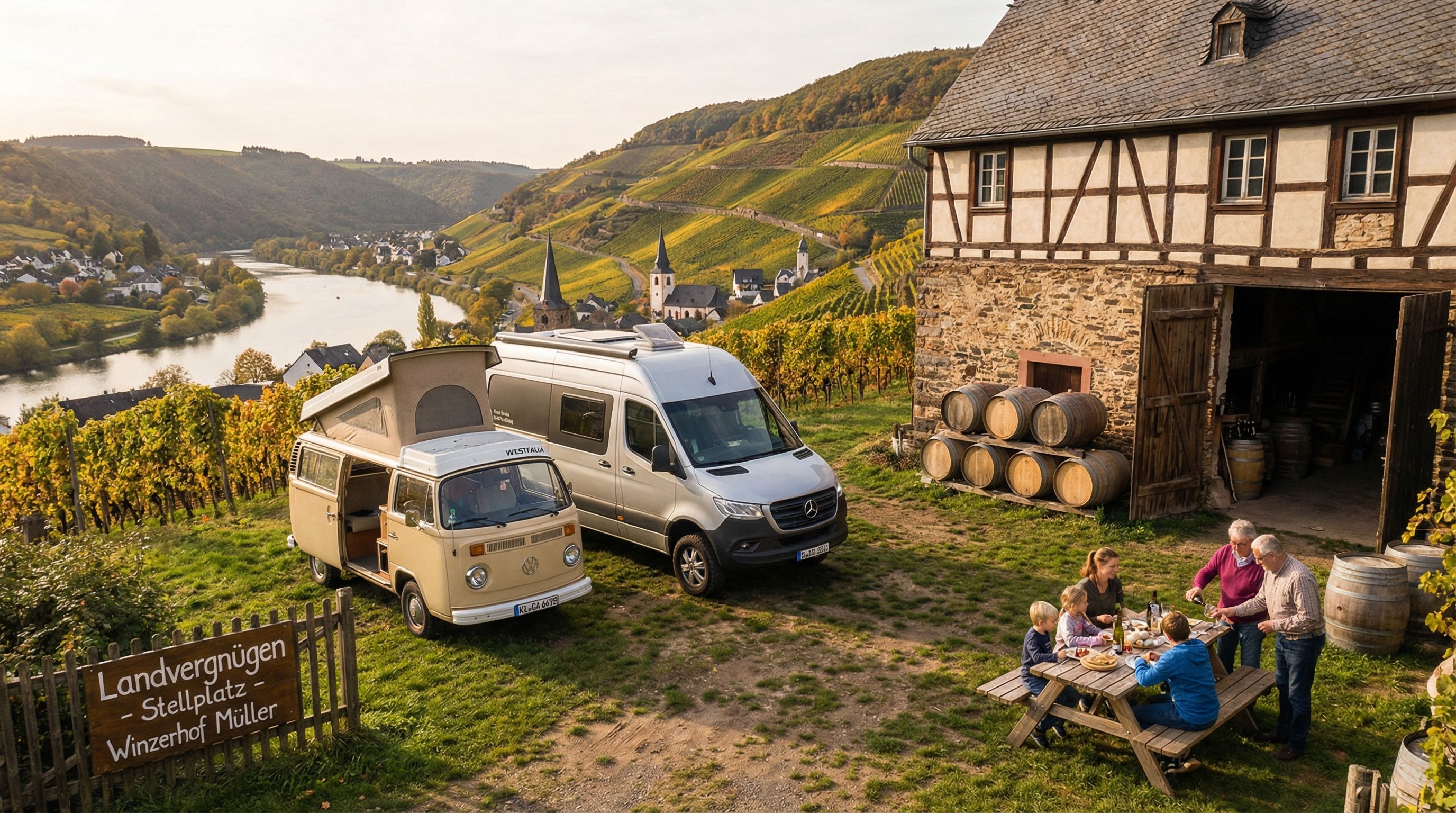 Landvergnugen farm stays offer unique experiences at over 1,200 German farms and vineyards.
Costs and What to Expect
German Stellplatze range from completely free to surprisingly expensive luxury spots. Here's what your money gets you:
| Price Range | What You Get | Examples |
|---|---|---|
| Free | Basic parking, sometimes services | Rural municipal lots, some Autohofs |
| EUR5-15 | Water, waste, basic electricity | Most municipal Stellplatze |
| EUR15-25 | Good facilities, nice location | Tourist areas, private sites |
| EUR25-40 | Premium location, full services | Lake shores, city centers |
| EUR40-60+ | Luxury - wellness, WiFi, reservable | Resort-style Stellplatze |
Additional Fees to Budget For
- Electricity (Strom): EUR2-5 per night or metered
- Showers: EUR0.50-2 per use (token or coin)
- WiFi: EUR2-5 where available (rare)
- Tourist tax (Kurtaxe): EUR1-3 per person in spa towns
Pro Tip: Germany has over 450 completely free Stellplatze. They're often in smaller villages, lack electricity, but can be perfectly adequate for a night.
Payment Methods
Payment systems vary widely, so preparation is essential:
| Payment Type | Description | How Common |
|---|---|---|
| Coin machines | Insert coins, receive ticket | Very common |
| Barrier systems | Pay at machine, barrier opens | Common in cities |
| EC/Giro card | German debit cards only | Increasingly common |
| Envelope system | Cash in envelope, honor box | Rural areas |
| App payment | RoamLife, EasyPark | Growing |
| Credit card | Visa/Mastercard | Rare |
Critical advice: Always carry EUR20-30 in coins (EUR1 and EUR2 pieces) and small notes. Many machines don't give change, and card readers often reject non-German cards.
Facilities Guide
Understanding German facility terminology helps when checking listings:
| German Term | English | Description |
|---|---|---|
| Frischwasser | Fresh water | Potable water fill-up |
| Grauwasser | Grey water | Sink/shower waste disposal |
| Entsorgung | Disposal | Black waste/chemical toilet emptying |
| Strom | Electricity | Power hookup (usually 16A) |
| Duschen | Showers | Usually coin-operated |
| WC | Toilets | Public toilet access |
| WLAN | WiFi | Internet access (rare) |
| Waschmaschine | Washing machine | Laundry facilities (rare) |
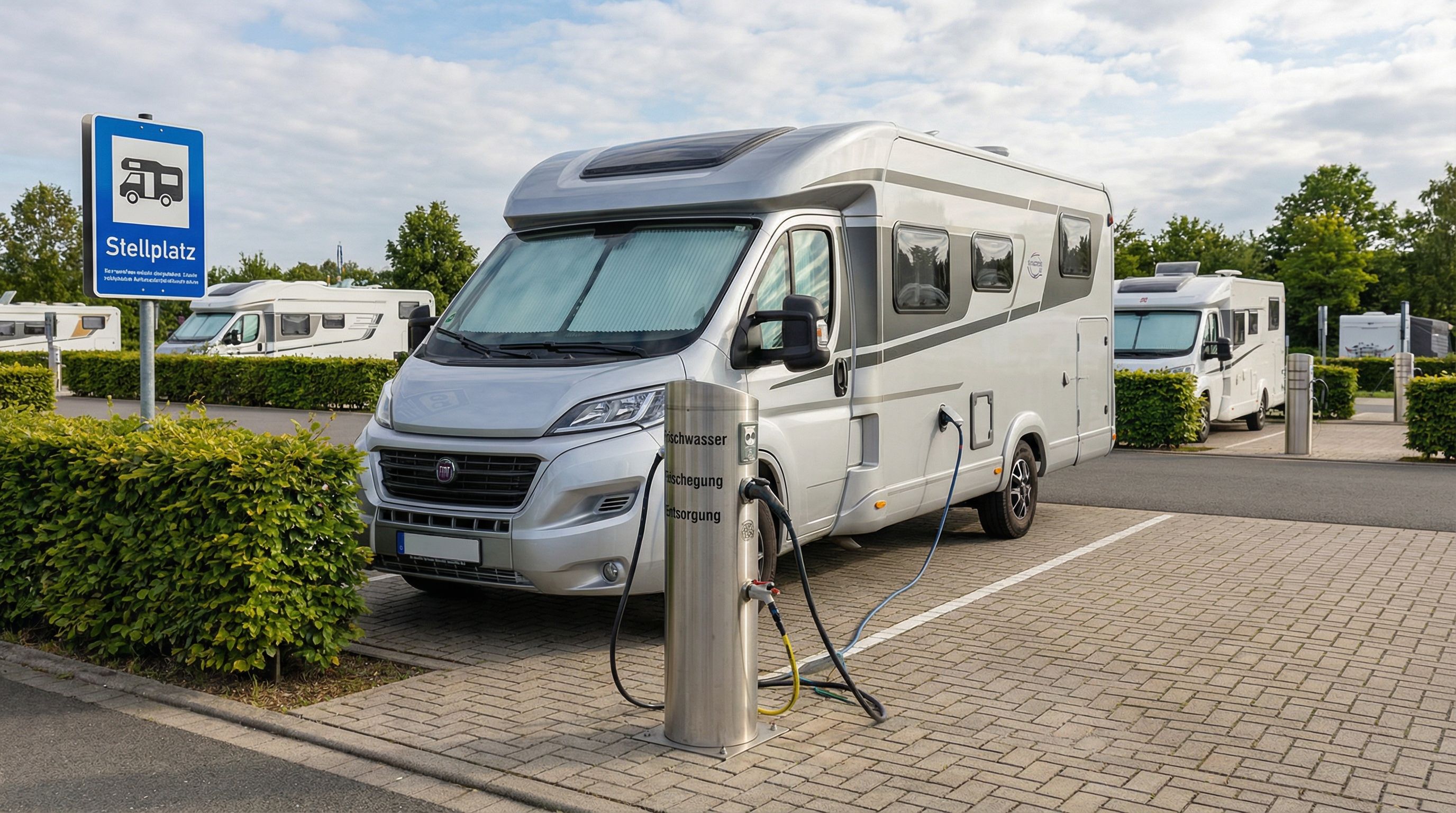 A typical German Stellplatz service point - most offer fresh water (Frischwasser) and waste disposal (Entsorgung) facilities.
Typical Facility Availability
| Facility | Availability |
|---|---|
| Fresh water | Common (90%+) |
| Grey waste disposal | Very common (85%+) |
| Chemical toilet disposal | Common (80%+) |
| Electricity | Common (70%+) |
| Toilets | Sometimes (50%) |
| Showers | Uncommon (30%) |
| WiFi | Rare (15%) |
Regional Highlights
Bavaria (Bayern) - 790+ Stellplatze
Germany's largest and most visited state offers everything from Alpine drama to beer-garden culture. It's also the strictest for wild camping enforcement.
Top spots:
- Fussen - Gateway to Neuschwanstein Castle, multiple Stellplatze
- Garmisch-Partenkirchen - Alpine views, skiing, hiking
- Berchtesgaden - Near Hitler's Eagle's Nest, stunning lake
- Rothenburg ob der Tauber - Romantic Road's star attraction
| Bavaria Quick Facts | Details |
|---|---|
| Stellplatze count | 790+ |
| Average cost | EUR15-25 |
| Best season | May-October |
| Wild camping fines | EUR500+ |
Regional note: Bavaria enforces camping rules strictly. Fines for illegal overnight parking in nature reserves can exceed EUR2,500.
Black Forest (Schwarzwald) - 540+ Stellplatze
The Black Forest offers dense woodland, cuckoo clocks, and excellent driving roads. The B500 scenic route is particularly recommended.
Top spots:
- Titisee - Lake swimming, multiple waterfront Stellplatze
- Freiburg - University city, gateway to the region
- Baden-Baden - Historic spa town (book ahead)
- Triberg - Germany's highest waterfalls, cuckoo clock capital
| Black Forest Quick Facts | Details |
|---|---|
| Stellplatze count | 540+ |
| Average cost | EUR10-18 |
| Must-drive | B500 Schwarzwaldhochstrasse |
| Unique feature | Winzeratlas wine farm stays |
Baltic Coast (Mecklenburg-Vorpommern) - 300+ Stellplatze
Germany's least populated state offers beautiful beaches, islands, and a more relaxed approach to regulations than the south.
Top spots:
- Rugen Island - Germany's largest island, chalk cliffs
- Stralsund - UNESCO World Heritage old town
- Rostock-Warnemunde - Beach resort, ferry port
- Usedom - Seaside architecture, Polish border
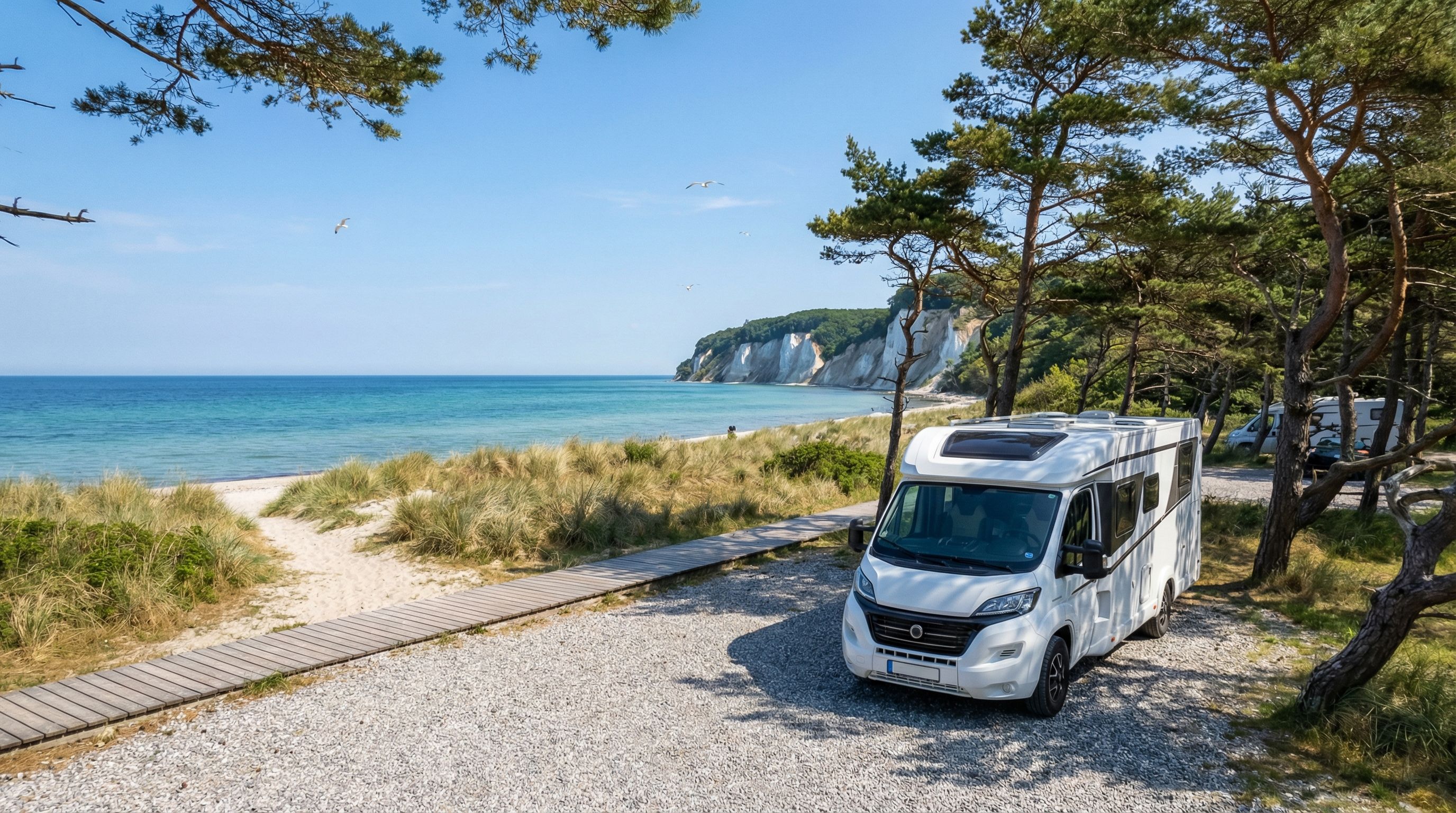 Rugen Island on Germany's Baltic Coast offers stunning chalk cliffs and more relaxed camping regulations than the south.
| Baltic Coast Quick Facts | Details |
|---|---|
| Stellplatze count | 300+ |
| Average cost | EUR12-20 |
| Best season | June-September |
| Regulation approach | More relaxed than south |
Rhine & Mosel Valleys - 400+ Stellplatze
Wine country par excellence. The Mosel valley alone has dozens of Stellplatze at wineries through the Winzeratlas scheme.
Top spots:
- Cochem - Castle-topped town, excellent wine
- Rudesheim - Rhine Gorge, cable car views
- Bernkastel-Kues - Half-timbered wine town
- Koblenz - Rhine-Mosel confluence, fortress
| Rhine/Mosel Quick Facts | Details |
|---|---|
| Stellplatze count | 400+ |
| Average cost | EUR12-20 |
| Wine scheme | Winzeratlas (200+ winemakers) |
| Best season | April-October |
Lower Saxony (Niedersachsen) - 630+ Stellplatze
From North Sea beaches to the Harz Mountains, Lower Saxony offers geographic diversity and a strong Stellplatz network.
Top spots:
- East Frisian Islands - Car-free islands (ferry from mainland)
- Goslar - UNESCO medieval mining town
- Hamelin - Pied Piper legend town
- Luneburg Heath - Purple heather in August-September
Legal Rules You Must Know
German motorhome law operates on a principle called "Wiederherstellung der Fahrttuchtigkeit" - restoration of fitness to drive. This creates a narrow legal exception for overnight parking.
What's Legally Permitted
- One night in a regular parking space if needed to restore driving fitness
- Maximum 10 hours for this exception
- No camping behavior - sleep only, no outdoor living
- Official Stellplatze are explicitly permitted for overnight stays
What's Prohibited
- Wild camping on any public land
- Camping behavior (awnings, outdoor furniture, cooking outside)
- Staying multiple nights in regular parking without moving
- Overnight parking in nature reserves (high fines)
- Using generators (especially 22:00-07:00)
Regional Fine Differences
| Region | Wild Camping Fine | Nature Reserve Fine |
|---|---|---|
| Bavaria | EUR500+ | EUR2,500+ |
| Baden-Wurttemberg | EUR250-500 | EUR1,500+ |
| Northern states | EUR100-250 | EUR500-1,000 |
| Schleswig-Holstein | Most lenient | EUR500+ |
Practical reality: Use official Stellplatze and you'll have zero problems. Germany has so many that there's rarely any reason to risk parking elsewhere.
How to Find Stellplatze
Apps and Websites
| Resource | Coverage | Offline | Cost | Best For |
|---|---|---|---|---|
| stellplatz.info | 4,300+ Germany | Website | Free | Comprehensive German listings |
| RoamLife | Excellent | Yes | Free | AI-powered recommendations, weather integration |
| Promobil App | Very good | Yes | Free/Premium | German-focused, reliable |
| Campercontact | Good | Yes | EUR8.50/year | User reviews |
| Google Maps | Variable | Yes | Free | Quick "Stellplatz" search |
Guidebooks
Bordatlas is the definitive printed guide, updated annually with thousands of Stellplatze. Available in German only, but photos and symbols are universal.
On-the-Road Signs
Look for the official blue motorhome symbol with "Stellplatz" or "Wohnmobil Stellplatz." Many towns have brown tourist signs directing you to local facilities.
Practical Tips From Experience
Arrival Strategy
- Arrive before 16:00 in peak season - popular Stellplatze fill early
- Check opening hours - some close gates overnight
- Read signs carefully - restrictions, fees, and time limits vary
- Take photos of payment receipts and time tickets
Self-Sufficiency Pays Off
Stellplatze assume your vehicle is self-contained. The more independent you are, the better your experience:
- Full water tanks and empty waste before arriving
- Solar panels or leisure battery for electricity independence
- Portable toilet to extend range between service points
Etiquette That Matters
- Quiet hours: Strictly observed 22:00-07:00
- Space claiming: Don't spread out - one vehicle, one pitch
- Generator use: Almost universally prohibited
- Dog waste: Always clean up (Germans are particular about this)
- Departure: Leave by the posted time, usually 10:00-12:00
Money Matters
- German Stellplatze are not cheap compared to France
- Budget EUR20/night average in tourist areas
- Free Stellplatze exist but often lack electricity
- Kurtaxe (tourist tax) adds EUR1-3/person in spa towns
Best Time to Visit
| Season | Pros | Cons | Best Regions |
|---|---|---|---|
| Summer (Jun-Aug) | Long days, festivals, swimming | Crowded, expensive | Baltic Coast, Alps |
| Spring (Mar-May) | Wildflowers, quiet | Variable weather | Rhine/Mosel, Black Forest |
| Autumn (Sep-Nov) | Wine harvest, fall colors | Shorter days | Wine regions, Bavaria |
| Winter (Dec-Feb) | Christmas markets, skiing | Cold, some closures | Bavaria, Harz, cities |
Christmas markets tip: Germany's famous Weihnachtsmarkte run late November through December. Stellplatze in market towns book up quickly - arrive early in the day or consider nearby villages.
Germany vs France: How Do They Compare?
If you've read our Complete Guide to Aires in France, you might wonder how German Stellplatze stack up:
| Aspect | Germany (Stellplatze) | France (Aires) |
|---|---|---|
| Number | 4,300+ | 5,000+ |
| Average cost | EUR15-20 | EUR8-12 |
| Free options | 450+ | 1,000+ |
| Electricity | More common | Less common |
| Facilities quality | Generally higher | More variable |
| Wild camping tolerance | Very low | Low |
| Signposting | Excellent | Good |
| Payment | Often cash/EC only | More card options |
Germany costs more but generally delivers better facilities. France offers more free options and a more relaxed atmosphere. Both countries excel at motorhome infrastructure.
Frequently Asked Questions
What does Stellplatz mean in English?
Stellplatz translates to "parking place" or "pitch." In motorhome context, it specifically means a designated overnight parking area for self-contained campervans and motorhomes.
Can I wild camp in Germany?
Wild camping is prohibited throughout Germany. The "restoration of driving fitness" exception allows one overnight in a regular parking space if genuinely needed, but camping behavior is never permitted. For legal overnight options, see our Wild Camping Laws in Europe guide. Always use official Stellplatze for stress-free travel.
Are Stellplatze suitable for campervans or only large motorhomes?
Stellplatze welcome all self-contained vehicles - from compact campervans to large motorhomes. The key requirement is having your own toilet and waste storage. Some pitches may have height or length restrictions, so check listings for larger vehicles (8m+).
Do I need to book Stellplatze in advance?
Most Stellplatze operate first-come, first-served. However, popular locations in peak season (especially Bavaria in summer, anywhere during Oktoberfest, and Christmas market towns in December) can fill by mid-afternoon. A few premium Stellplatze accept reservations - check individual listings.
What payment methods work at German Stellplatze?
Cash is king - always carry EUR20-30 in coins (EUR1 and EUR2 pieces). German EC/Giro cards work widely, but foreign credit cards are often rejected. App payments through RoamLife or EasyPark are growing but not universal.
How long can I stay at a Stellplatz?
Typically 1-3 nights maximum. Check signage on arrival - many municipal Stellplatze limit stays to 24 or 48 hours. Longer stays require moving to a proper campsite.
What is Landvergnugen and is it worth it?
Landvergnugen is Germany's equivalent to France Passion - a EUR49 annual membership granting free overnight stays at 1,200+ farms, vineyards, and producers. If you plan extended touring in Germany, it's excellent value and offers unique experiences you won't find at regular Stellplatze.
Planning Your German Stellplatz Trip
Germany's Stellplatz network makes motorhome travel straightforward. With 4,300+ legal overnight options, well-marked facilities, and clear rules, you can focus on enjoying the country rather than worrying about where to sleep.
Start planning your route:
- Download RoamLife or stellplatz.info before departure
- Carry sufficient cash (coins and small notes)
- Understand that Germany costs more than France but delivers reliable facilities
- Respect quiet hours and the "no camping behavior" rule
The infrastructure exists. The destinations are spectacular. All you need to do is go.
Last updated: January 2026


